
Subtotal ₦0.00

Email :165
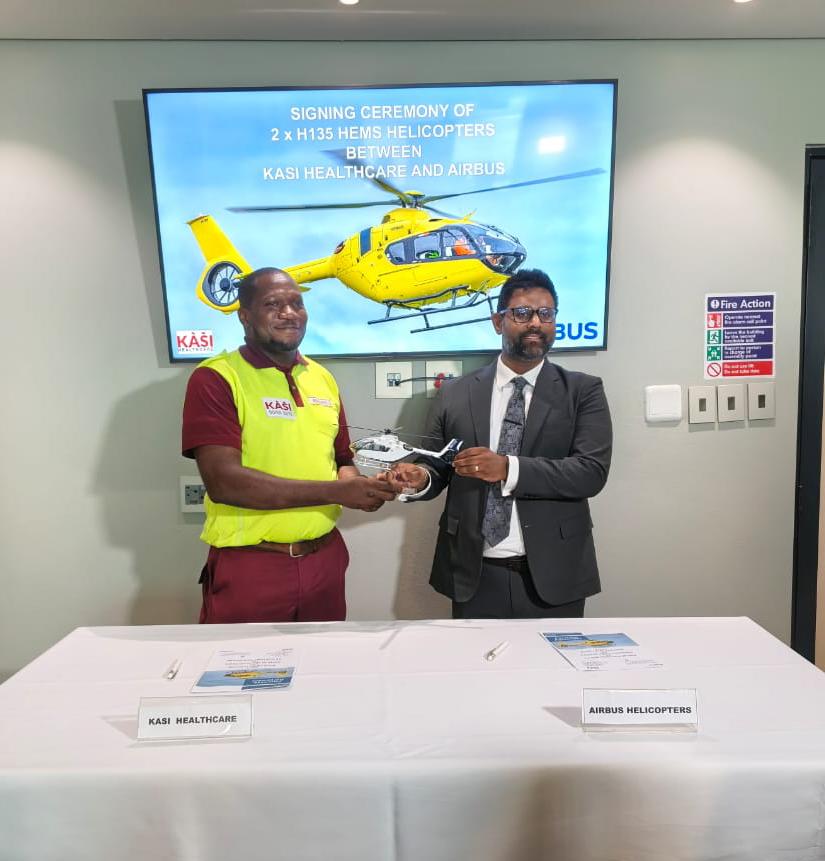
LAGOS, NIGERIA — Airbus Helicopters and Kasi Healthcare partnership signals the emergence of a dedicated air medical services ecosystem in Nigeria.
For decades, emergency healthcare delivery in Nigeria has been constrained by a familiar challenge: time.
Whether responding to road traffic accidents on congested highways, evacuating injured workers from offshore oil installations, or transferring critically ill patients between hospitals, delays in accessing emergency care have often meant the difference between life and death.
That reality may be beginning to change.
The recent agreement between Kasi Healthcare and Airbus Helicopters for the acquisition of up to two HEMS-configured Airbus H135 helicopters marks more than a routine aircraft procurement deal.
It represents the introduction of a specialised Helicopter Emergency Medical Services (HEMS) capability into Nigeria’s healthcare and aviation landscape—a development that could fundamentally reshape emergency medical response in the country.
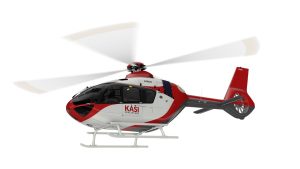
Announced during the Nigeria Airlift 2026 Forum in Lagos, the agreement positions Kasi Healthcare as the first operator in Nigeria to acquire a purpose-built Airbus H135 configured specifically for medical evacuation and emergency healthcare missions.
While helicopters have long been used in Nigeria’s oil and gas industry, VIP transportation, security operations, and corporate travel, dedicated air ambulance services remain largely underdeveloped.
The introduction of HEMS signals the emergence of a new aviation segment focused exclusively on saving lives.
Closing the Golden Hour Gap
Medical experts often refer to the “golden hour”—the critical period following a severe injury or medical emergency during which prompt treatment significantly improves survival chances.
In many parts of Nigeria, reaching advanced medical facilities within that window can be difficult.
Heavy urban traffic, poor road conditions, long distances between specialist hospitals, and limited emergency transportation infrastructure often delay patient care.
A dedicated HEMS operation offers a solution by providing rapid transportation for critically ill or injured patients while enabling medical intervention during flight.
With specialised medical equipment and trained personnel onboard, air ambulances effectively transform helicopters into flying intensive care units.
For victims of road accidents, industrial incidents, cardiac emergencies, strokes, or other life-threatening conditions, the ability to reach specialist treatment facilities quickly can dramatically improve outcomes.
Supporting Nigeria’s Energy Sector
The significance of HEMS extends beyond conventional healthcare delivery.
Nigeria’s offshore oil and gas industry employs thousands of personnel working in remote environments where access to advanced medical facilities is limited.
Medical evacuations from offshore platforms frequently require rapid air transport to specialised hospitals onshore.
The Airbus H135 has established itself globally as one of the preferred aircraft for such missions because of its reliability, advanced avionics, operational flexibility, and cabin configuration that accommodates both medical crews and critical care equipment.
The aircraft’s capabilities could strengthen emergency preparedness within Nigeria’s energy sector while improving safety standards for offshore operations.
Building a New Aviation Ecosystem
Perhaps the most significant aspect of the Airbus-Kasi partnership lies beyond the aircraft themselves.
The agreement includes comprehensive support covering pilot training, HEMS crew development, engineering capacity building, maintenance support, and operational standards.
This creates opportunities for the development of specialised skills that currently have limited presence in Nigeria.
A fully functional HEMS ecosystem requires highly trained pilots capable of operating emergency missions, aviation engineers familiar with specialised medical aircraft, flight paramedics, emergency physicians, dispatch coordinators, and maintenance personnel.
As the sector grows, it could generate new employment opportunities while expanding Nigeria’s aviation expertise.
The initiative also aligns with broader efforts to increase local capacity within the aviation industry and reduce dependence on foreign technical support.
Strengthening National Emergency Preparedness
Globally, helicopter emergency medical services play a vital role in disaster response, search and rescue operations, humanitarian missions, and public safety emergencies.
Countries with established HEMS networks rely on them during natural disasters, mass casualty incidents, security emergencies, and major transportation accidents.
For Nigeria, which faces recurring challenges ranging from road accidents to flooding and industrial emergencies, dedicated air medical capability could become an important component of national emergency response planning.
The availability of specialised medical helicopters can significantly enhance the ability of healthcare providers and emergency agencies to respond effectively to crises.
A Regional Opportunity
The introduction of the first HEMS-configured Airbus H135 may also strengthen Nigeria’s ambition to become a regional aviation leader.
As West Africa’s largest economy and most populous nation, Nigeria possesses the scale and market potential to pioneer advanced emergency aviation services that could eventually serve neighbouring countries.
If successfully implemented and expanded, the model could encourage further investment in air medical services across the region, improving healthcare accessibility beyond Nigeria’s borders.
More Than an Aircraft Acquisition
While the acquisition of two helicopters may appear modest on the surface, its broader implications are far-reaching.
The Airbus-Kasi Healthcare partnership represents the beginning of a specialised aviation capability that bridges healthcare, emergency management, and transportation.
For a country seeking to modernise its healthcare infrastructure and strengthen emergency response systems, the introduction of dedicated helicopter emergency medical services could prove to be a landmark development.
The success of the initiative will ultimately depend on sustained investment, regulatory support, skilled personnel, and integration with existing healthcare systems.
But for now, the arrival of Nigeria’s first HEMS-configured Airbus H135 offers a glimpse into a future where critical medical care can reach patients faster, regardless of distance, terrain, or traffic, and in emergency medicine, every minute matters.
On the Regulatory Side
Dr Esther Shittu, General Manager, Aeromedical Standards at the Nigeria Civil Aviation Authority (NCAA) highlighted some points from the regulatory side of the acquisition.
Air ambulances are now equipped with personnel and medical equipment, acting as ICUs in the air. Empirical data supports the benefits of air ambulance services globally, including in Nigeria. Capacity building and training are essential for effective air ambulance operations. Strategic coordination and planning are crucial for successful air ambulance operations. Air ambulance services in Nigeria are currently limited to private arrangements and high executives. There is a need to establish helicopter ambulance services in Nigeria through public-private partnerships. Regulatory frameworks must be established to ensure compliance with international standards.
Data management and documentation are vital for convincing stakeholders of the effectiveness of air ambulance services. Government policy and funding are necessary to support the development of air ambulance services. The civil aviation regulations in Nigeria align with international conventions for air ambulance operations. Lagos State has a robust ambulance service and preparedness for emergencies. Training health workers for emergency interventions is part of the preparedness strategy. The goal is to create a streamlined model for air ambulance services with trained personnel and ready hospitals. Collaboration with international standards and local regulations is essential for successful implementation.
Eoin Walter, Senior HEMS Segment Promoter at Airbus Helicopters speaking on the partnership, praised Dr Dayo Osholowu, the Medical Director of Kasi Healthcare for his commitment, noting that Osholowu’s push has earned Nigeria a shift in the Aeromedical ecosystem.
Dr Osholowu explained that a pre-feasibility study was conducted by Madakems Academy and Airbus in Nigeria to initiate a project and that the project involved developing a business plan and gaining stakeholder support.
He said aAln academy was established in partnership with ADAC Helms Academy, becoming their West Africa site. The academy offers a full portfolio of medical courses and plans to offer pilot training courses.
Accoridng to him, the strategic acquisition of two helicopters aims to develop capacity and improve data collection while data and cooperation are emphasised as key components for the project’s success. The Airbus H135 platform was chosen for its success, safety profile, and support system.
Osholowu added that Airbus provides options for models, ideas, and financing, enhancing collaboration. Recent government initiatives have improved financing options for aircraft in Nigeria. Financing for aircraft now includes seven to ten-year terms, making it more feasible.
“He noted that the project aims to improve health infrastructure, crucial for survival amid challenges. Investing in capacity is seen as essential for resilience against unforeseen challenges. The project provides a safety net for emergencies, such as road accidents or oil rig incidents.”
The initiative is a response to unprecedented challenges like COVID-19 and rising insecurity. The project aims to ensure survival and resilience in the face of rapid global changes.
