
Subtotal ₦0.00

Email :69
By Mercy Odeh (Content Editor)
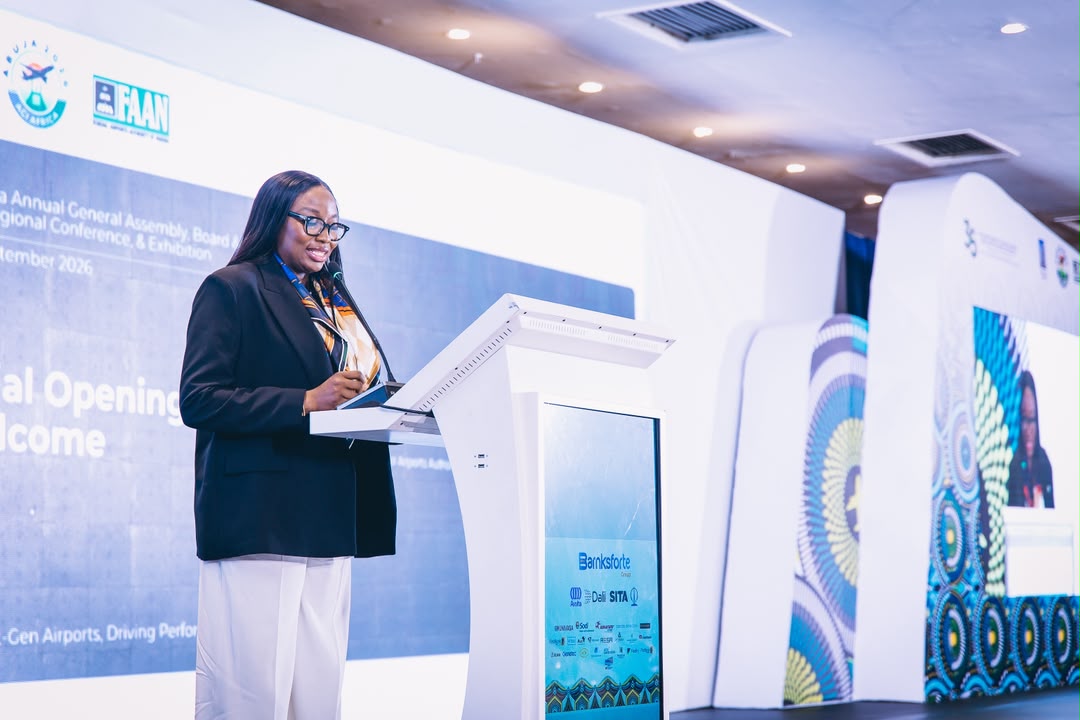
ABUJA — Africa’s aviation sector is recording stronger passenger growth than the global average, with international passenger demand rising by 6.4 per cent year-on-year in July 2026, Managing Director of the Federal Airports Authority of Nigeria (FAAN), Mrs Olubunmi Onabanjo-Kuku, has said.
Onabanjo-Kuku disclosed this on Tuesday in Abuja while delivering the welcome address at the 2026 Airport Council International (ACI) Africa Regional Conference and Exhibition at the Abuja Continental Hotel.
She said the growth was significant against a 0.1 per cent decline in global international passenger demand during the same period.
According to Onabanjo-Kuku, Africa’s overall passenger demand grew by 5.2 per cent, second only to Latin America and the Caribbean and ahead of the global average of 0.2 per cent.
“This continent is on the move,” she said, noting that the figures represented millions of Africans connecting with families, doing business, accessing healthcare and exploring new opportunities.
However, Onabanjo-Kuku cautioned that growth alone was not enough, as the continent continued to face funding constraints, infrastructure gaps, high operating costs, fragmented connectivity and pressure to maintain affordable charges while delivering world-class airport facilities.
The 2026 conference, themed “Next-Gen Airports: Driving Performance and Resilience,” brings together airport executives, regulators, airlines, financiers, technology providers and other aviation stakeholders to discuss the future of African airports.
Nigeria’s aviation growth
On Nigeria, Onabanjo-Kuku said the country’s aviation market was now the fourth-largest in Africa, with more than 18.8 million domestic and international passengers recorded in 2025, representing an 11.9 per cent year-on-year increase.
She said the Murtala Muhammed International Airport, Lagos, recorded the fastest growth in scheduled seat capacity among Africa’s 10 largest airports in September, with a 24.1 per cent increase.
Nigeria’s total scheduled airline capacity also reached 1.19 million seats in September 2026, representing a 37.4 per cent increase over the same period last year, she said.
She attributed the growth to currency reforms, new aircraft leasing agreements and growing confidence among international carriers.
According to her, several airlines had resumed operations in Nigeria since the current Minister of Aviation and Aerospace Development assumed office, with more expected.
On FAAN’s transformation, Onabanjo-Kuku said the authority had prioritised infrastructure modernisation, passenger experience, digital transformation, quality management, human capital and cargo development.
She said FAAN had rehabilitated a major runway at the Lagos airport, upgraded terminals and improved airfield lighting while maintaining operations.
The authority had also established a Passenger Experience Hub and deployed digital check-in systems, automated e-passport gates, enhanced security systems and passenger-data analytics.
She added that FAAN achieved ISO 9001:2015 and ISO 14001:2015 certifications in January 2026, while more than 3,500 personnel had been trained and certified through ICAO and ACI programmes.
Looking ahead, Onabanjo-Kuku identified five priorities for next-generation African airports: financial sustainability, intelligent infrastructure, operational resilience, human capital and partnerships.
She called for greater diversification of airport revenue beyond aeronautical charges, saying airports should develop into commercial ecosystems supporting logistics, hospitality, retail and airport-city development.
She also urged governments to provide predictable and commercially disciplined frameworks for infrastructure investment, while calling on development partners and financial institutions to recognise airports as strategic economic infrastructure.
Onabanjo-Kuku said Africa had demonstrated resilience through currency crises, health emergencies, supply-chain disruptions and geopolitical uncertainty.
“The decade ahead belongs to Africa. Our passenger growth is outpacing the rest of the world. Our infrastructure is being renewed. Our institutions are strengthening. Our connectivity is expanding,” she said.
She urged stakeholders to use the conference to strengthen partnerships and develop practical strategies for building more resilient, efficient and sustainable airports across the continent.
ACI’s role in African aviation
The Airports Council International (ACI), the global association representing airports, was established in 1991 following the consolidation of earlier international airport organisations. ACI provides a platform for airports to collaborate, share expertise and promote the development of safe, secure and sustainable air transport.
ACI Africa, one of ACI’s regional bodies, represents the interests of airports across the continent and promotes professional excellence in airport management and operations.
