

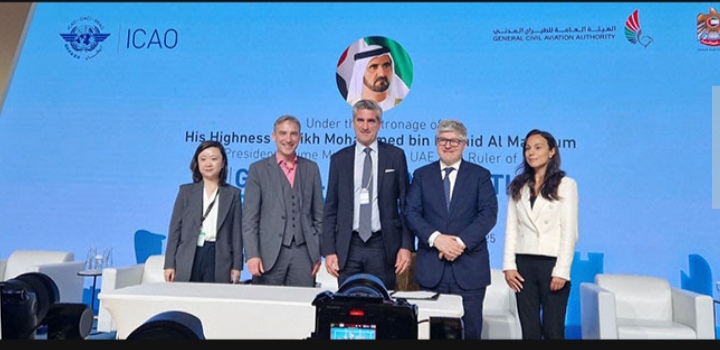
MONTREAL and ABU DHABI – The International Civil Aviation Organisation (ICAO), says it is pursuing its work toward the establishment of a global platform that will directly connect aviation sustainability projects with investors worldwide.
The support for its creation was formalised recently through a Letter of Intent signed at ICAO’s Global Implementation Support Symposium by ICAO Secretary General, Juan Carlos Salazar, alongside representatives from Airbus, Boeing, the International Power-to-X Hub, and GenZero.
The platform will be known as ICAO Finvest Hub, to facilitate dedicated pathways for funding sustainable aviation fuel production facilities, clean energy infrastructure, and other aviation decarbonization initiatives.
This will provide critically important support to the aviation sectors’ efforts, including the urgent need to scale up sustainable aviation fuel (SAF) production and deployment to meet demand.
The ICAO Council President, Salvatore Sciacchitano had said: “The success of aviation’s environmental transition depends on strong partnerships and accessible funding, particularly for developing States.
“The establishment of the Finvest Hub exemplifies the power of international cooperation in addressing our shared environmental responsibilities.
“Through this platform, we are acting on our commitment to achieve net-zero carbon emissions by 2050, while implementing the Global Framework for Sustainable Aviation Fuels adopted in Dubai,” Sciacchitano said.
According to Salazar, the Finvest Hub introduces access to new financial mechanisms specifically designed for aviation sustainability projects.
“By connecting technical expertise with innovative financing solutions, we’re creating practical pathways to increase production of sustainable aviation fuels and other cleaner energy sources. These projects will serve as engines of economic growth while advancing environmental protection across our Member States.”
It was agreed that the ICAO Finvest Hub will: “Connect projects contributing to the decarbonization of international aviation with potential public and private investors.
“Create pathways for the funding of projects contributing to the decarbonisation of international aviation.
“Prioritise the provision of support to developing countries and States facing unique challenges in financing projects contributing to the decarbonisation of international aviation.
“Actively engage with governments, financial institutions, and private sector stakeholders to encourage and accelerate access to new and additional funding for projects contributing to the decarbonisation of international aviation.”
The initiative emphasises support for developing countries through targeted technical assistance, capacity building, and guidance on establishing legal and policy frameworks that attract sustainable aviation investments.
Sustainable aviation fuels (SAF), lower carbon aviation fuels (LCAF), and other cleaner energy solutions are expected to be a significant focus for the Finvest Hub, given that these are expected to significantly contribute to the long-term global aspirational goal for international civil aviation of net-zero carbon emissions by 2050.


Comments are closed